Cold-Weather Yoga Apparel: Fleece-Lined and Layered OEM Specs
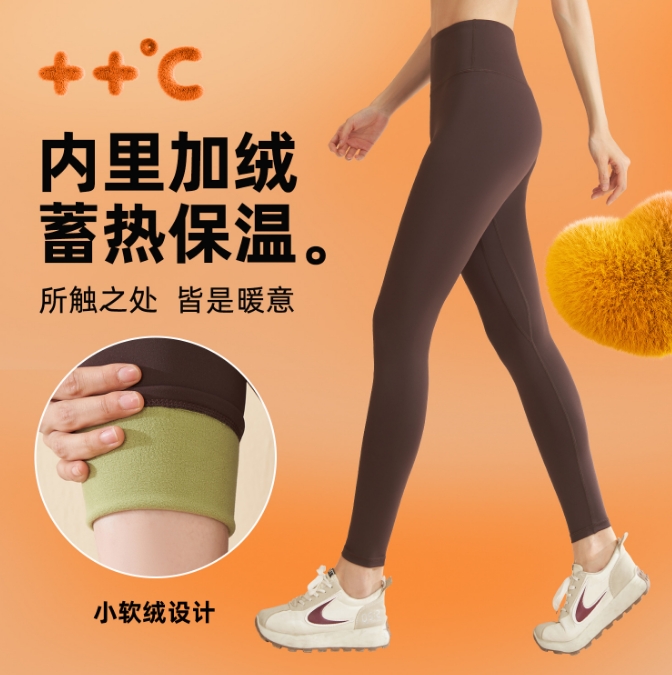
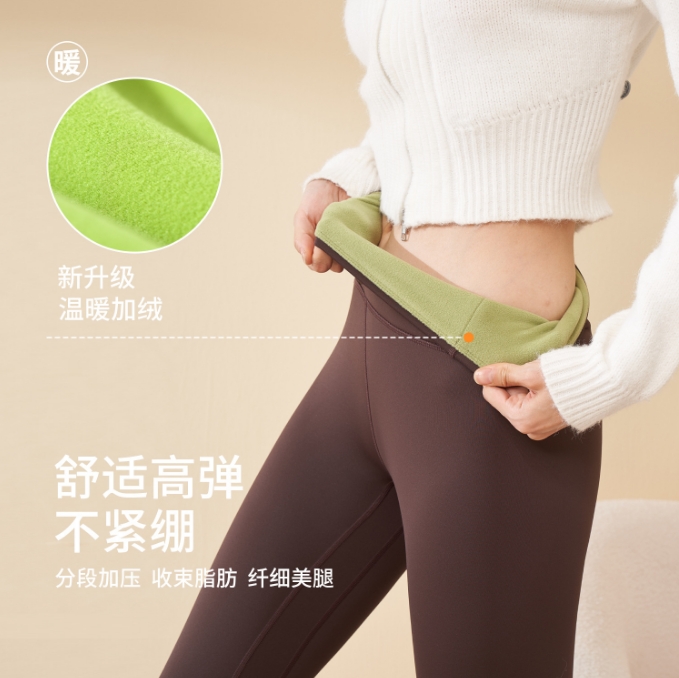
Cold-weather yoga apparel is a lining decision before it is a design decision. A winter drop works when the shell that touches the outside world stays the same high-elasticity polyester-spandex knit your studio range already uses, and the warmth comes from a brushed inner face bonded behind it rather than from a heavier single knit. Printing Yoga runs that construction in production today: the Peach-bottomed fleece yoga pants and the Peach-colored down-lined hooded coat both carry an outer layer of 82.5% polyester, 17.5% spandex over an inner layer of 94% polyester, 6% spandex, while the Loose-fitting zip-up hooded sweater sits on a separate 21% cotton, 79% polyester fiber base. This guide covers what that means for OEM buyers planning a cold-season capsule, and which details to lock before manufacturing starts.
Warmth comes from the inner face, not from a thicker knit
The instinct when a brand adds winter products is to ask the factory for heavier fabric. That is usually the wrong lever. A single heavy knit loses the stretch recovery that makes activewear feel like activewear, and it takes far longer to dry after a class or a cold commute. The bonded build solves both problems at once: the outer layer keeps the hand and the recovery of the shell you already approved, and the inner layer traps air against the skin.
Look at what the pants and the coat have in common. Both use 82.5% polyester, 17.5% spandex outside and 94% polyester, 6% spandex inside. That is not a coincidence of the catalogue — it is a sourcing advantage. One fabric approval, one colour standard and one dye lot can carry a bottom and an outer piece through the same production window, which is exactly what a small label needs when it does not have the buying power to hold several separate material lines open.
The hooded sweater deliberately breaks that pattern. At 21% cotton, 79% polyester fiber with ribbed trim at 19% cotton, 1.4% spandex, 79.6% polyester fiber, it is a lounge and studio-to-street piece, not a performance layer. Cotton content is what gives it the softer, drier hand people want off the mat, and it is also why it behaves differently in the wash than the bonded pieces do.
Four pieces, side by side
These are live catalogue products with their real compositions, so you can see where each one belongs in a cold-season range rather than guessing from a mood board.
| Piece | Outer / main fabric | Inner / secondary fabric | Where it earns its place | What to check on the sample |
|---|---|---|---|---|
| Fleece yoga pants | 82.5% polyester, 17.5% spandex | 94% polyester, 6% spandex | Cold studio floors and the walk to class | Waistband recovery, inner face after repeated washing |
| Down-lined hooded coat | 82.5% polyester, 17.5% spandex | 94% polyester, 6% spandex | Outer layer worn to and from the studio | Hood fit over tied-up hair, zip garage, cuff closure |
| Zip-up hooded sweater | 21% cotton, 79% polyester fiber | Rib at 19% cotton, 1.4% spandex, 79.6% polyester fiber | Lounge, travel and studio-to-street wear | Rib recovery at cuff and hem, dimensional change after wash |
| Half-zip long-sleeve top | 88% polyester fiber, 12% spandex | Mesh net at 89% polyester fiber, 11% spandex | Base layer worn under either outer piece | Mesh placement, flat seams where a strap or bag sits |
Read the table as a layering system rather than as a list. The half-zip top is the only piece designed to be worn under something else, and its mesh net is placed to vent the heat a bonded outer piece traps. Sell the pieces separately and each one still works; sell them as a set and the mesh becomes the reason the set works.
Conditional rules we apply on a sourcing call
If you are adding one winter piece to an existing leggings range, make it the fleece pants. They convert an audience that already trusts your fit, they need no new silhouette conversation, and they run on the same shell composition as your warm-season bottoms — so your existing size chart and fit experience carry straight across.
If you supply studios in a cold climate, spec the coat and the half-zip top together and treat them as a pair. Students arrive layered and start the class warm; the top is what they practise in and the coat is what they arrive in. Ordering only the outer piece leaves the more frequently repurchased item out of your range.
If you want the whole drop to clear on a single fabric approval, keep it to the bonded pieces and hold the hooded sweater for a second wave. Its cotton-rich base is a different supply line with its own shrinkage behaviour and its own lead time, and folding it into a first winter order is the fastest way to have one late component delay every other carton.
If you need a genuine down-filled parka, a merino base layer, or a hemp or bamboo sweatshirt, that sits outside our manufacturing capacity and we would rather say so before you build a line sheet around it. What we offer is high-elasticity polyester-spandex knits and the cotton-polyester blend above; we can help you match colour and hand inside that range, but we do not quote materials we do not run.
Branding a lined piece without wrecking it
Logo placement on a bonded garment is a different problem from logo placement on a single-layer legging. Heat applied to the outer layer travels into the inner layer, so the safe positions are the ones with a seam or a facing behind them — chest, sleeve, hem band, hood edge. Our OEM and ODM services cover custom colours, sizing and branding across these products, and the pattern room will tell you during sampling if a position you have chosen is going to distort the loft behind it.
Two practical habits save the most rework. First, approve the branding on the actual lined fabric, never on a swatch of the shell alone, because the two behave differently under the press. Second, ask for your winter designs to be laid out on the sample size you sell the most of — a graphic scaled from a size chart rather than from a real garment is the most common reason a first bulk run comes back looking unbalanced.
Frequently asked questions
What cotton, hemp or bamboo options do you have?
We run one cotton-rich piece, the zip-up hooded sweater at 21% cotton, 79% polyester fiber, and we do not produce hemp or bamboo goods at all. If a natural-fibre story is central to your brand, take that requirement to a mill that specialises in it rather than asking us to substitute something close; we would rather lose the enquiry than ship a blend you did not actually want.
Can you match colour across the fleece pants and the coat?
Yes, and it is much easier than most buyers expect because both pieces share the same outer composition of 82.5% polyester, 17.5% spandex. Same fibre, same dye behaviour, so a single approved standard covers the pair. Matching the hooded sweater to them is a separate conversation: cotton takes dye differently, and an exact match across the two bases is not something we would promise on a first run.
How long does a lined winter piece take compared with a legging?
Longer, and the extra time sits in sampling rather than in bulk. A bonded garment needs the lining approved as well as the shell, and the fit sample has to be checked with both layers in place. Plan your delivery window backwards from the season you are selling into, not forwards from the day you send artwork, and build in room for one extra fit round.
Do I need a different factory for the hooded sweater?
No. All four pieces above are produced under the same roof and the same quality standards, which is the whole point of keeping a cold-weather capsule inside one supplier. What changes is the material line feeding the cutting room, and that is a scheduling question our team handles when we plan capacity for your order.
What should I lock before placing a winter bulk order?
Four things, in this order: shell and lining composition for every piece, the colour standard, branding position confirmed on lined fabric, and the size set you are grading from. Everything else — packaging, labelling, carton marking — can be settled later without holding up production, and locking these first is what lets us ensure the run starts on schedule.
Where to start
A cold-weather range does not need to be wide to work. One bottom, one outer layer and one base layer already create a complete story for a customer who practises through the winter, and all three can be built on fabrics we produce now. If you want to see how the pieces compare in person, request samples of the fleece pants and the half-zip top first — those two tell you more about our finishing standards than any other combination in the range.