Yoga Mat Holder or Carrier: Storing Mats Without Ruining Them
A yoga mat holder is studio and retail furniture, a carrier is something one person slings over a shoulder, and a carry bag is packaging that travels with the mat. They solve three different problems, and the spec that decides all three is the mat itself: material, width and thickness set the rolled diameter, and rolled diameter is what has to fit the rack slot, the sling loop or the bag tube. Pick the mat first and the holder follows from it. If you buy the holder first, you will be trimming your mat range to fit a fixture you already paid for.
Holder, carrier, bag: three jobs that do not overlap
Buyers use the three words interchangeably in search, but on a purchase order they are separate line items with separate suppliers and separate lead times. A holder is static storage — a wall rack, a floor bin, a retail display cradle — and it is bought once, sized to the deepest mat you will ever stock. A carrier is a sling or a strap the end user wears; it touches only the outside of the roll and cares about roll diameter, not about length. A carry bag is a sewn tube with a closure, and it is the only one of the three that is usually co-branded and shipped in the same carton as the mat.
The practical consequence for anyone placing a bulk order: the holder is a fixture decision, the carrier and bag are product decisions. Our manufacturing capacity covers mats, cushions and printed accessories; racks and shelving are not something we make, and we would rather say so than quote you something we do not control. What we can do is give you the real roll details so your fixture supplier sizes the slots correctly the first time.
What the mat's own spec decides
Three mats from our current range behave very differently once they are rolled, and each one pushes you toward a different storage format. The width is the number most fixture drawings get wrong, because a 68 cm mat does not fit a slot drawn for a 61 cm mat, and nobody notices until the first pallet lands.
| Mat | Material | Size (cm) | How it behaves rolled | Best storage format |
|---|---|---|---|---|
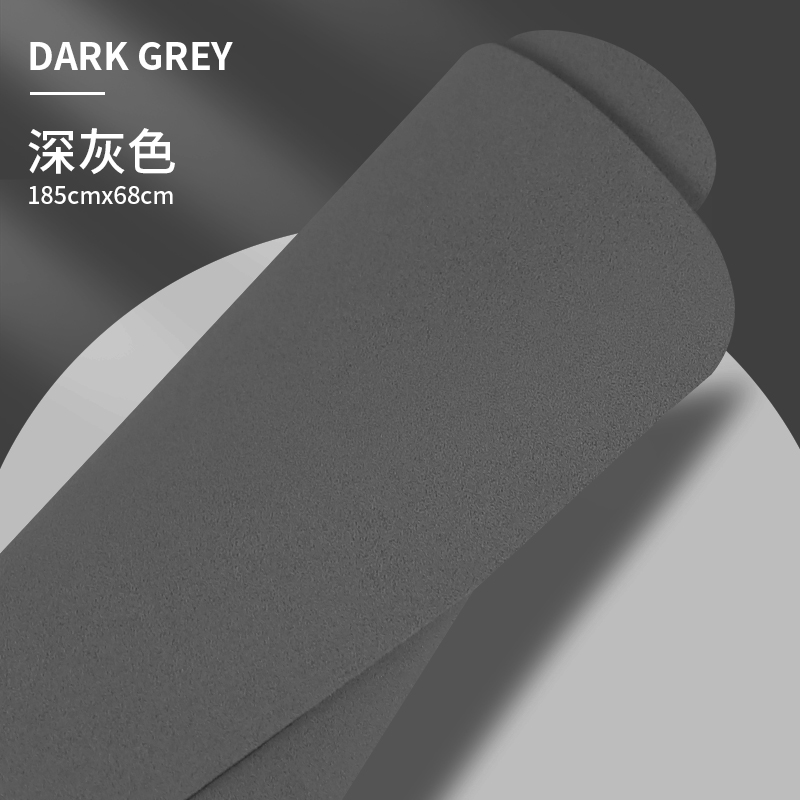
| Matte advanced mat | Frosted PU + Rubber | 185*68*0.45 | Dense and heavy; holds a tight roll, no crease memory | Vertical wall rack or deep floor bin |
| Foldable matte rubber mat | Frosted PU + Rubber | 185*68*0.15 | Folds flat instead of rolling; almost no bulk | Shelf or drawer; no rack slot needed |
| Double colour TPE mat | TPE | 183*61*0.8 | Thickest roll of the three; springs open if strapped loosely | Wide-slot rack or a bag with a real closure |
Read the table as a sizing rule rather than a ranking. Thickness drives diameter, width drives slot height, and material drives whether the roll stays shut on its own. The 0.8 cm TPE mat is the one that defeats undersized fixtures; the 0.15 cm foldable mat is the one that makes the whole holder question disappear, because a folded mat stacks like a towel.
If you… conditional verdicts
- If you run a studio and keep loaner mats on site, buy a holder sized to your thickest mat and standardise on one width. Mixed widths in one rack look untidy and slow down turnover between classes.
- If you are a retailer merchandising mats on a shop floor, the display cradle has to show the print, not just store the roll, so specify a cradle that leaves the top third of the roll visible and order mats with a print that reads well from the end of the roll.
- If you are bundling a carrier or bag with the mat, spec the mat first, then send the finished roll dimensions to whoever sews the bag. Reversing that order is the single most common reason a bundle sample comes back unusable.
- If you sell direct to consumers online and ship one mat per parcel, do not spec a holder at all — it is retail furniture, it will not earn its freight cost, and a simple sleeve or strap does the same job for the end user.
- If your range is built around the foldable mat, skip the rack budget entirely and put the money into shelf-ready cartons instead.
Storing mats so they still lie flat
Storage is not only about saving floor space; it decides what the customer sees when the mat is unrolled for the first time. Rubber mats stored upright on their end for long periods can deform along the bottom edge under their own weight, so store rolls horizontally in a rack whenever the stock will sit for more than a few weeks. Foldable mats are the opposite case: stored folded they keep their fold lines, which is expected and harmless, but stacking heavy cartons on top of them during transit will press those lines permanently. TPE mats are the most forgiving in storage and the least forgiving in a loose strap, because the thicker roll pushes back until something holds it.
Temperature matters more than most buyers expect. A warehouse that swings between hot afternoons and cold nights will make natural rubber stiffen and relax repeatedly, and a mat that has been through that cycle for a season unrolls with more curl than one that has not. Nothing about this is exotic — it is the same care any rubber goods warehouse already applies — but it belongs in your storage brief rather than in a complaint email six months later.
What to put in the enquiry
When you ask us to quote, the details that actually speed things up are the ones that pin down the roll: which mat, which width, which thickness, and whether a carrier or bag is part of the same order. Tell us the destination market and the delivery window as well, because a mat that ships loose and a mat that ships inside a sewn bag have different carton counts and different packing time. If you already have designs ready, send them at enquiry stage rather than after the quote — artwork is what we need to create an accurate sample, and holding it back only delays the first piece.
We can also help in the other direction. If you know the fixture you are stuck with — an existing rack, an existing shelf depth — tell us the slot size and we will tell you which mats in the range fit it. That is a faster conversation than redesigning your storage around a mat you have not bought yet. Our services cover the mat, the print and the packing; the quality standards we work to are the ones written into the sample approval, and the sample is what we measure against, not a description in an email. We would rather offer a high-quality match to a constraint you already have than ignore the constraint and ensure a problem later.
FAQ
Is a yoga mat holder the same thing as a carry bag?
No. One is a fixture that stays in a studio or shop, the other is packaging that travels with the user. They are bought from different suppliers, they have different lead times, and only the bag is normally co-branded with your artwork. The number they share is the rolled diameter of the mat.
How do I know what slot size my rack needs?
Work from thickness and width. A thicker mat makes a fatter roll, and a wider one makes a taller slot; the 0.8 cm TPE model is the deepest roll in our range, so a fixture sized around it will accept everything else too. Send us the models you plan to stock and we will confirm the real dimensions before you commission the drawing.
Can you make a carrier or bag that matches our mats?
Printed accessories are part of what we produce, so a matching sling or sleeve can go on the same order as the mats. The artwork has to be approved against both substrates, because a colour that looks right on rubber does not always land the same way on woven fabric. Ask for the pair as one sample set rather than two separate ones.
Will storing mats rolled for months damage them?
Rolled horizontally in a rack, no. Standing upright on one end for a long stretch is the situation to avoid, because the bottom edge carries the weight and can take a set. Foldable models are stored flat instead and are unaffected either way.
Do we have to pick one mat width for the whole range?
Not necessarily, but mixing widths costs you somewhere. Either the fixture is sized for the widest model and the narrow ones look lost in it, or you carry two fixtures. Studios with limited space usually standardise; retailers with a display wall often carry both deliberately, because the contrast sells the wider model.
What is the fastest way to start?
Pick two or three models from the range, tell us the quantity band and the market, and ask for the roll dimensions in writing. From there the fixture brief, the bag brief and the mat order can all be written from the same set of numbers, which is the whole point.