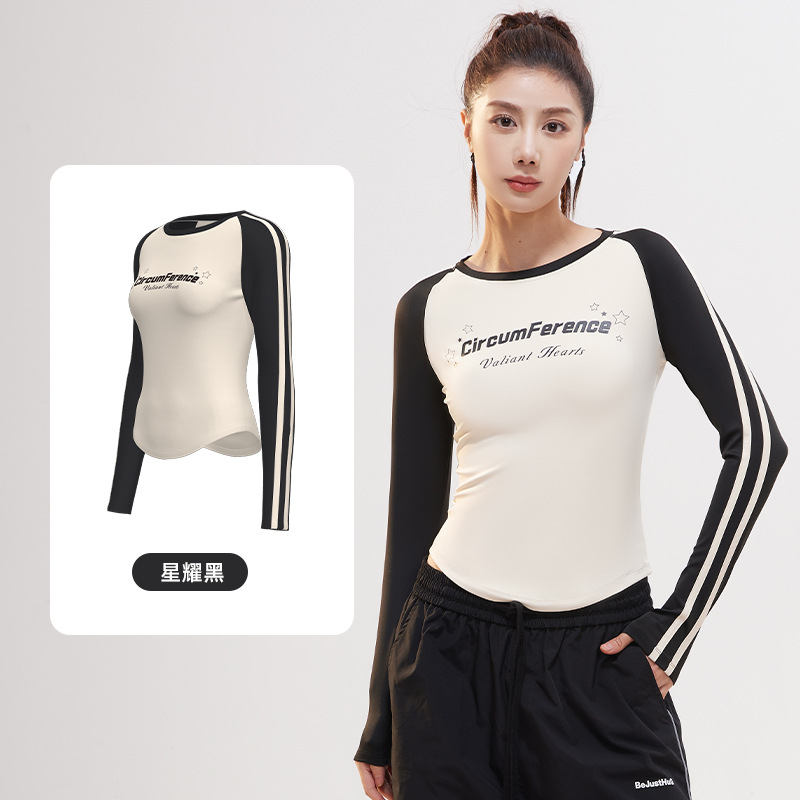
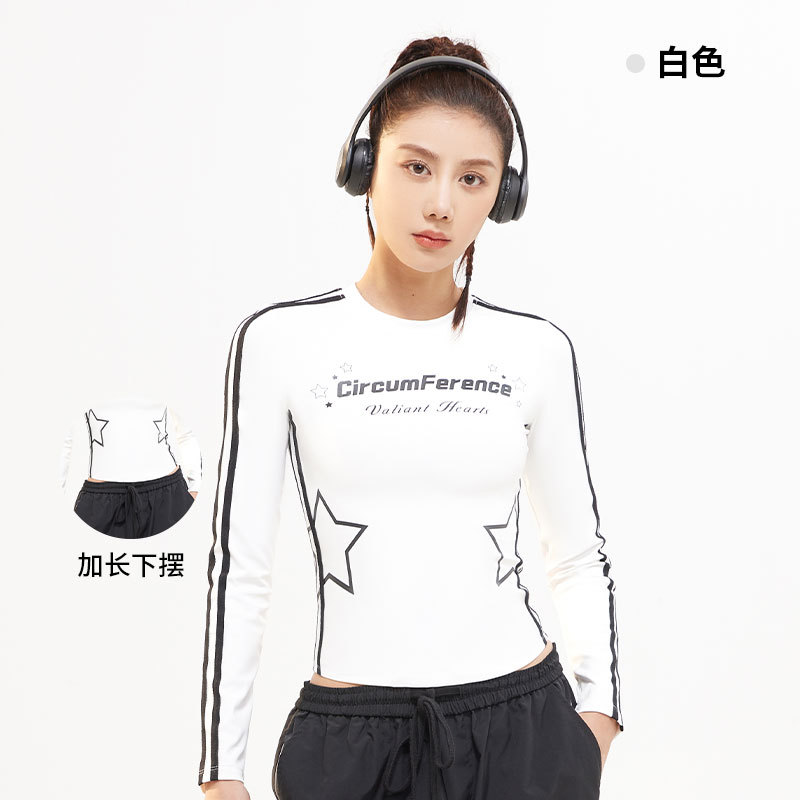
The print method for custom yoga activewear is decided by the fabric, not by the artwork. Dye sublimation bonds only to polyester, so a polyester-spandex body like our Peach letter print long-sleeved shirt (82.5% polyester fiber, 17.5% spandex) can be sublimated edge to edge, while a nylon-spandex body like the Polyamide letter-printed long-sleeved shirt (78% nylon, 22% spandex) cannot — nylon has no polymer for sublimation dye to enter, so that garment takes screen print, heat transfer or a nylon-compatible pigment ink instead. Check the fiber content first; every other decision about designs, cost and delivery follows from it.
Printing Yoga runs OEM and ODM manufacturing for yoga apparel, mats and cushions, and this is the first question our engineers ask on every tech pack we receive. Below is how each method behaves on the fabrics we actually stock, so you can create a print spec that survives production instead of one that gets re-quoted.
How the four print methods compare on stretch fabric
All four methods work on activewear, but they fail in different ways. The table compares them on the dimensions that matter for yoga products: whether the print survives a deep stretch, whether it breathes, and how well it fits small runs versus wide production capacity.
| Method | Works on | Hand feel after stretch | Best for | Main limit |
|---|---|---|---|---|
| Dye sublimation | Polyester-rich only (e.g. 82.5% polyester fiber, 17.5% spandex) | No coating — dye is inside the fiber, so it cannot crack or peel | All-over designs, gradients, photo prints, panel-to-panel patterns | Will not bond to nylon; cannot print white or light artwork on dark fabric |
| Screen print | Nylon and polyester, with the right ink system | Soft-hand plastisol or water-based ink; stretches with the panel if the additive is correct | Logos and letter marks in a few flat colors, repeated across a large run | Cost rises with each color; not viable for gradients |
| Heat transfer | Nylon and polyester | A film sits on the surface — noticeable on high-stretch panels | Small placement logos, size and care marks, sample runs | Edge lift after repeated wash and stretch if the panel flexes hard |
| Pigment / DTG-type ink | Cotton best; needs a bonding pre-treatment on synthetics | Slight surface film; softens over time | Short runs and one-off designs where artwork changes often | Weakest wash durability on nylon-spandex; the least predictable on our fabrics |
If you are choosing right now
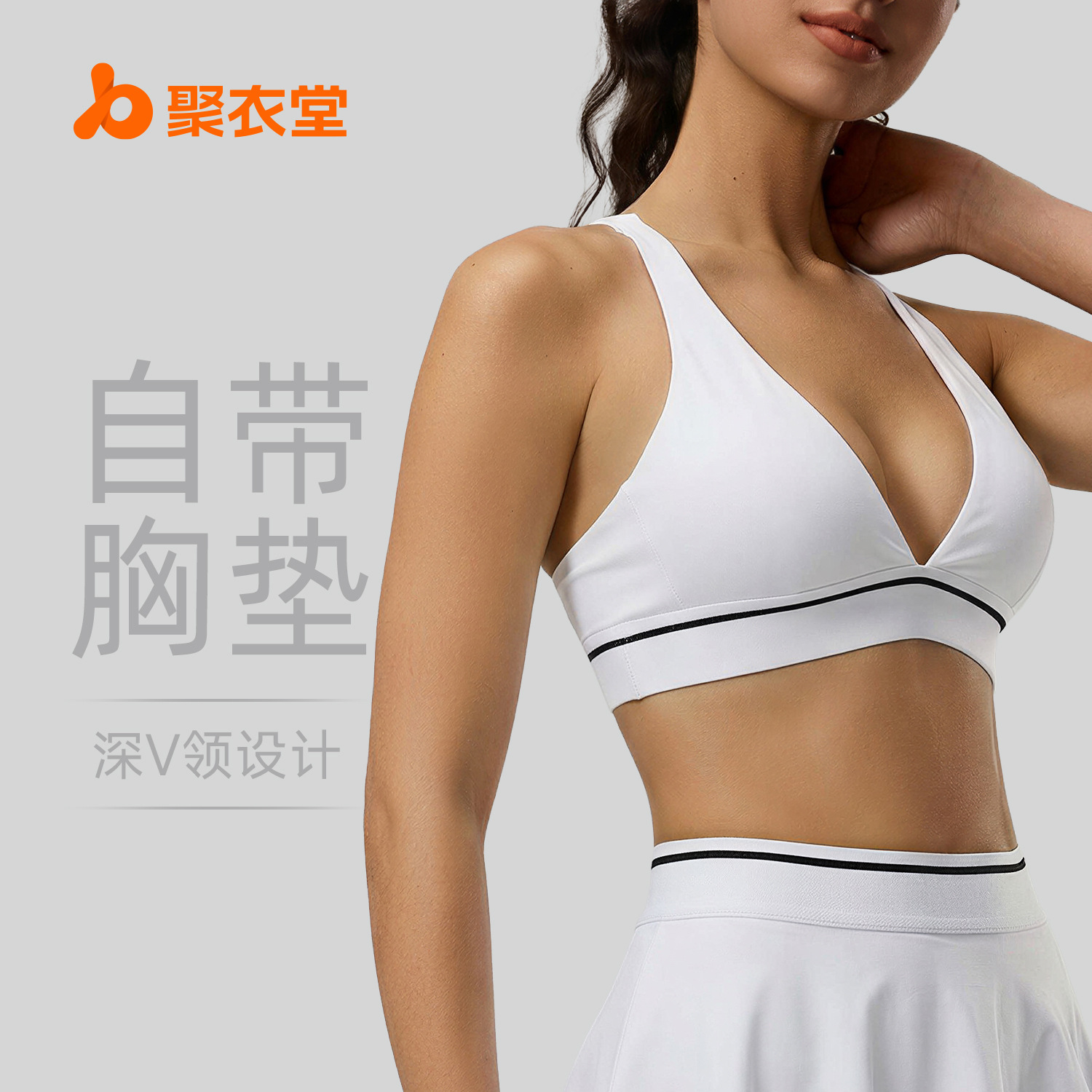
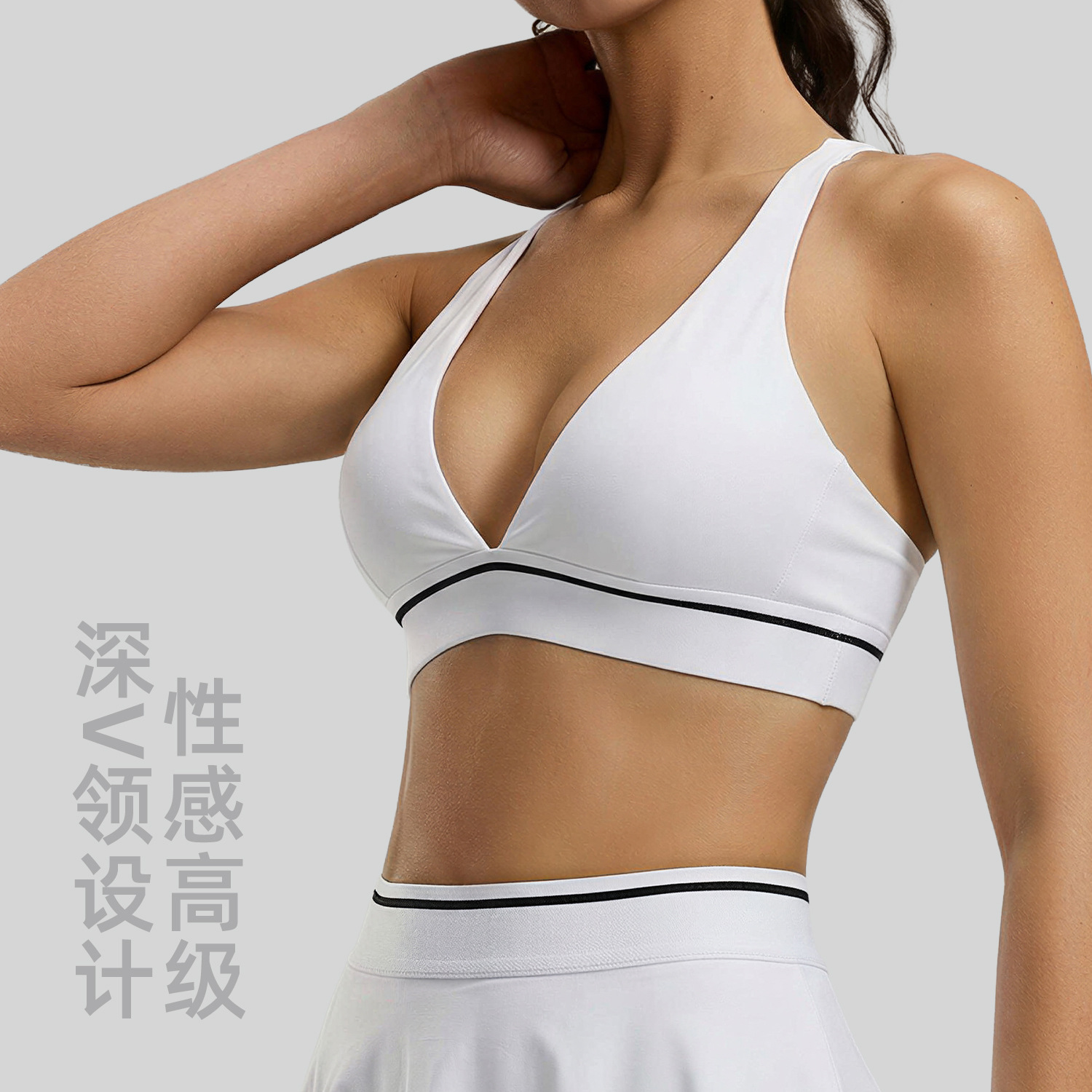
If you want an all-over or photographic print — a full-body pattern, a gradient, artwork that crosses a seam — specify a polyester-spandex body and sublimation. The Oreo Peach V-neck Bra is built for this: an outer layer of 82.5% polyester fiber, 17.5% spandex with 94% polyester fiber, 6% spandex mesh panels. Both layers are polyester-rich, so the pattern carries across the mesh without a change in hand feel, and the print cannot crack where the bra stretches most.
If your brand mark is a flat letter logo in one or two colors and you are ordering a full size run, choose screen print. Cost per piece drops as the run grows because the screens are made once, and a correctly formulated soft-hand ink moves with the fabric. This is the standard route for a letter-print top in Cool Tea Black, Merlot Red or White across S to XXL.
If you are still testing designs and expect artwork to change between drops, use heat transfer on a small placement while you validate the market, then move to screen or sublimation once the design settles. Transfers need no screens, so you can change artwork per sample without a tooling charge.
If your garment is nylon-spandex, do not specify sublimation — this is the exclusion that costs brands the most time. No pre-treatment, ink upgrade or press setting makes sublimation dye bond to nylon; the color will wash out because it never entered the fiber. If you have already approved a sublimated all-over design and your chosen body is 78% nylon, 22% spandex, you must change one of the two: switch to a polyester-spandex body, or convert the artwork to a screen-printed placement. We flag this on the tech pack rather than quote around it.
What we need from you to quote a print
To help us quote accurately, send the fiber content you want, artwork in vector or at print resolution, the placement and its dimensions, the colorway list, and the size range. Our engineers return a print spec that names the method, the ink system and the wash standards the sample will be tested against. We produce a strike-off before bulk so you approve the real print on the real fabric — a screen on cotton paper tells you nothing about how the ink behaves on spandex.
You can compare our stock bodies and their exact fiber content on the product pages: the Polyamide letter-printed long-sleeved shirt, the Peach letter print long-sleeved shirt and the Oreo Peach V-neck Bra. Each lists its material so you can match a method before you commit to a design.
FAQ
Looking for a manufacturer/supplier for yoga activewear — what should I check first?
Ask for the fiber content of every body they offer, and ask what print method they would use on it. A factory that answers "any print, any fabric" has not thought about it — sublimation genuinely cannot bond to nylon. Then ask to see a strike-off on the actual fabric, and ask which wash standards their samples are tested to. A supplier that shows you a print failure mode before you order is more useful than one that only shows finished photos.
Looking for activewear manufacturers for a new brand, premium quality — do you take tech packs?
Yes. Send the tech pack with fiber content, artwork, placement, colorways and size range, and our engineers return a print spec and a sample. If your tech pack pairs an all-over sublimated design with a nylon body, we raise it before sampling rather than after — that single check saves a full sample cycle.
Can I sublimate a nylon-spandex top if you pre-treat it?
No. Pre-treatment helps pigment inks grip a synthetic surface, but sublimation works differently: the dye turns to gas and enters the polyester polymer itself. Polyamide fiber offers no site for it, so on a 78% nylon, 22% spandex body the color would sit on the surface and wash away within a few cycles. Use screen print or heat transfer on that fabric instead.
Will a printed logo crack where the fabric stretches?
It depends on the method. A sublimated print cannot crack, because there is no layer on the surface to crack — the dye is in the fiber. Screen print with a correctly formulated soft-hand ink flexes with the panel. Heat transfer film is the most likely to lift at the edges over time, which is why we keep transfers to small placements and away from high-stretch panels like a bra's mesh.
Which fabric should I pick if I want a wide range of colorways?
Polyester-spandex, printed by sublimation. Because the color is applied as artwork rather than dyed into stock fabric, adding a colorway costs you a file, not a new roll. Our polyester bodies already ship in multiple colorways — the Peach letter print long-sleeved shirt in Cardamom Green, Cocoa Color, Starlight Black and Whale Blue, the Oreo Peach V-neck Bra in Distilled Coffee, Pink Diamond, Starlight Black and White — and custom colorways follow the same route.
Do you offer small test runs before bulk?
Yes. Sampling and small runs exist so you can validate fit, hand feel and print durability before committing production capacity. Heat transfer is usually the fastest route for a test print because it needs no screens; once the design is locked, we move it to the method that gives the best durability on your chosen fabric.
Print method is a fabric decision first and an aesthetic decision second. Match the two correctly and the print outlives the garment; match them wrong and no amount of press tuning will save it. If you want us to check a spec you have already drafted, send the fiber content and the artwork, and we will tell you which of the four methods your design actually supports.