
An outdoor yoga mat is a mat specified for grass, sand, decking and rooftop concrete rather than a studio floor, and the spec change is almost entirely about the surface: a closed-cell top that dirt and dew cannot soak into, a backing that grips uneven ground instead of a polished one, and a roll or fold that survives being thrown in a car boot. If you are sourcing outdoor-facing products, the three mats we make most often for this use are PVC at 183*61*0.6cm, double-colour TPE at 183*61*0.8cm, and a foldable TPE at 183*61*0.4cm.
The mistake we see most in outdoor range planning is treating "outdoor" as a marketing word rather than a material decision. Studio mats are engineered for a clean, flat, dry floor. Take the same construction outside and it fails in a predictable order: the top layer wicks up moisture, grit embeds in the pores, the mat stops being washable, and the customer returns it in a season. Below are the details that actually matter when you create an outdoor line, and the OEM decisions behind each one.
What outdoor use actually changes in the spec
Closed-cell top, not open-cell. An open-cell surface (raw natural rubber, suede, cotton) is designed to absorb sweat so it grips in a hot room. Outdoors that same porosity absorbs dew, sand and lawn dirt, and there is no way to wash it out. A closed-cell top such as PVC or TPE wipes clean with water, which is the single biggest driver of outdoor product satisfaction.
Cushioning over hard, uneven ground. Studio floors are sprung or carpeted. Concrete, decking and packed earth are not. Outdoor mats sell better at higher thickness because the mat has to make up for the ground underneath it. Our double-colour TPE at 183*61*0.8cm exists for exactly this reason, and it is the version we recommend for rooftop and park-class programmes.
Pack-down and carry. Nobody carries a studio roll across a beach. A foldable construction such as the TPE at 183*61*0.4cm folds flat instead of rolling, so it fits a tote or a backpack. Thinner means less cushioning, so this is a transport trade-off, not a free upgrade.
Print method has to survive the outdoors too. This is where most outdoor ranges are under-specified. Latex-printed and water-colour designs sit on the surface and are the most vulnerable to abrasion from sand and grit. Laser-printed alignment lines are burned into the material, so there is no ink layer to scuff off. For an outdoor SKU we normally steer customers to laser marking or single-colour bodies with a laser logo, and keep full-surface printing for indoor products. Our guide to print durability on mats covers the same comparison in more depth.
If you are choosing between constructions
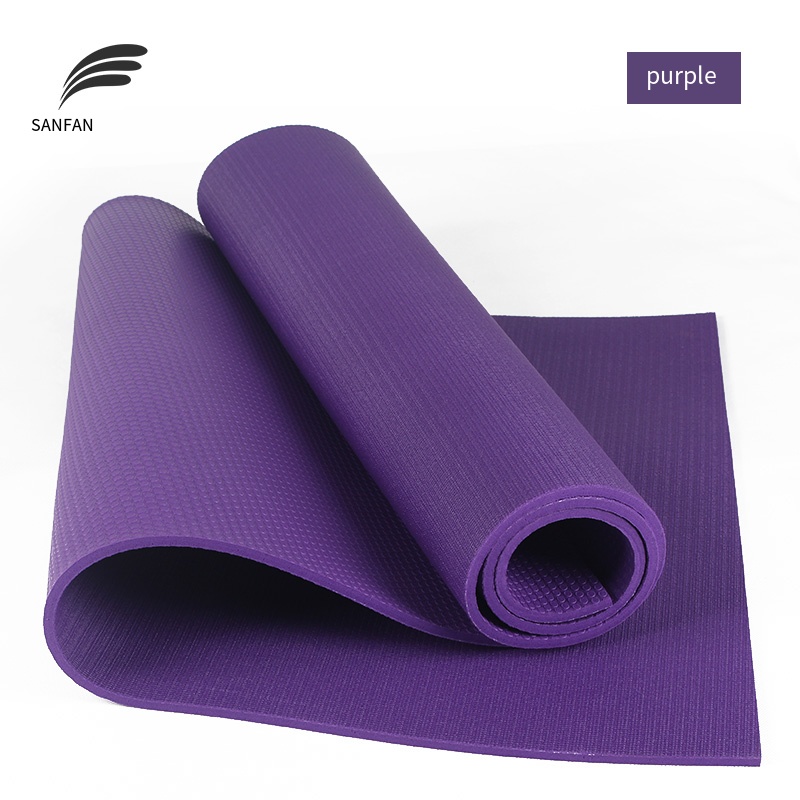
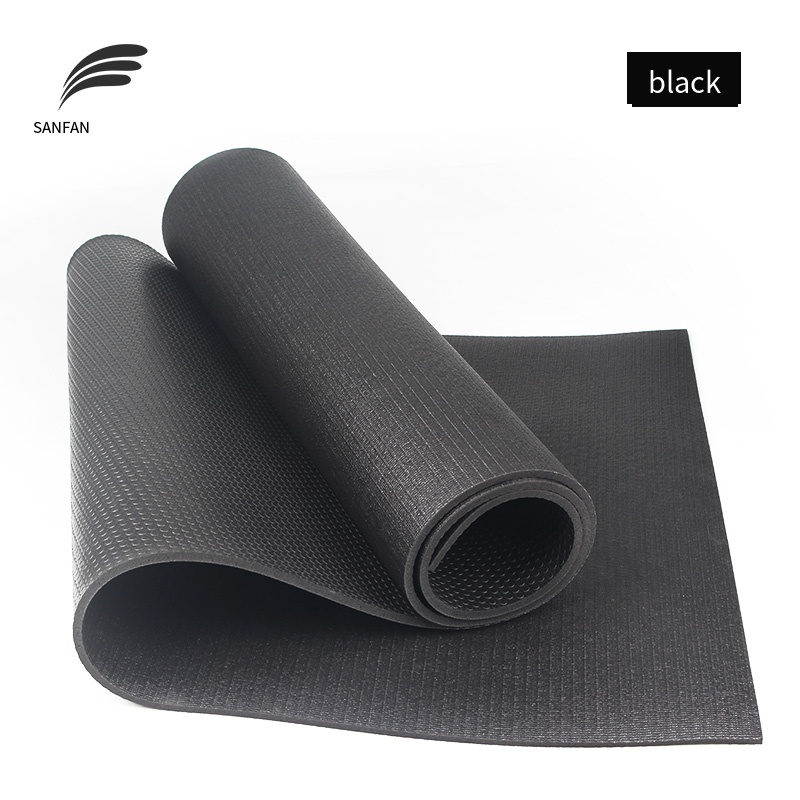
If you sell to beach, park and festival programmes where the mat gets sandy every single session, specify a closed-cell PVC body. The PVC mat at 183*61*0.6cm in Black, Burgundy and Purple is the one we ship most for this, because it takes a hose, dries fast, and the laser alignment lines cannot wash off. Make this your default outdoor SKU unless something below overrides it.
If your customers practise on rooftop concrete or decking, go thicker rather than grippier. The double-colour TPE at 183*61*0.8cm is the comfort answer: the extra cushioning is doing the work the floor is not. Expect higher shipping cost per unit and plan freight accordingly.
If the mat has to be carried further than a car park — travel yoga, retreats, hotel and resort amenity programmes — specify the foldable TPE at 183*61*0.4cm. It folds rather than rolls, which changes the pack shape completely and lets you design retail packaging that fits a standard shelf.
If you need an eco or natural-material claim on the label, do not force it into the outdoor SKU. This is the exclusion we give most often. Natural rubber and suede-topped mats are genuinely better products indoors, and we are happy to make them, but they are the wrong tool for sand and dew: the top layer will hold dirt and the mat will look used within weeks. Put your natural-material story on the studio line and keep the outdoor line synthetic and washable. Trying to make one mat do both is how outdoor ranges get returned.
Outdoor mat comparison: surface, cushioning and print method
| Spec | PVC 183*61*0.6cm | TPE 183*61*0.8cm double colour | Foldable TPE 183*61*0.4cm |
|---|---|---|---|
| Material | PVC | TPE | TPE |
| Surface type | Closed-cell, wipe-clean | Closed-cell, wipe-clean | Closed-cell, wipe-clean |
| Ground it suits | Sand, grass, decking | Concrete, rooftop, packed earth | Any, when carry weight rules |
| Cushioning | Mid | Highest of the three | Lowest of the three |
| Pack format | Roll | Roll | Folds flat |
| Best print method outdoors | Laser alignment lines | Laser marking on colour body | Laser marking on colour body |
| Surface printing outdoors | Not recommended | Not recommended | Not recommended |
| Body position lines available | Yes | Yes | Yes |
All three are made on the same lines in our own factory, so you can mix them in one order and one shipment. That matters more than it sounds: outdoor demand is seasonal, and being able to move capacity between a beach SKU and a studio SKU inside one purchase order is usually worth more than a small unit-price difference. Our custom artwork service is where you upload designs and pick the marking method for each SKU.
Outdoor yoga mat FAQ
Can you just use a normal yoga mat outside?
You can, once. The problem is not the first session, it is the tenth: an open-cell top absorbs whatever it is lying on, and grit works into the surface where washing cannot reach it. A closed-cell mat takes a hose and dries. If the product will live outdoors, specify for that from the start.
What thickness should an outdoor mat be?
Thicker than your studio equivalent, because the ground gives you nothing back. For concrete and decking we point customers at the 183*61*0.8cm build; for mixed use where carrying matters, the 183*61*0.4cm foldable trades cushioning for pack size. There is no single right answer, only which trade-off your customer feels first.
Will printed designs fade or scratch outdoors?
Surface ink is the weak point, not the mat body. Sand acts like fine abrasive, so full-coverage printing wears visibly on an outdoor SKU. Laser marking removes that failure mode because the mark is in the material rather than on it. We will tell you this before you order rather than after.
Is a beach yoga mat different from an outdoor mat?
Same construction logic, harsher input. Sand is more aggressive than grass on both the surface and any printing, and it finds its way into every pore, so the closed-cell requirement is absolute rather than a preference. Everything else — thickness, fold format, marking method — follows the same rules as any other outdoor product.
Can you make outdoor mats with our own logo and colours?
Yes — that is the whole of what we do. We are the manufacturing side, not a reseller: single-colour bodies with a laser-marked logo, custom colourways, and alignment lines are all standard options, and we handle the artwork setup as part of the service. Send us the use case and we will help you choose the construction before anyone commits to a sample.
How do you ensure the quality is consistent between production runs?
By keeping it in one factory and holding the same material standards run to run, rather than re-sourcing the body each season. Consistency is the thing customers notice during a repeat order, and it is also what makes a high-quality outdoor line defensible in reviews. Ask us for a sample from live production, not a showroom piece, and check the surface finish yourself before delivery of the main run.
Outdoor is a small, specific corner of the mat market, but it is one where the wrong material is obvious to the end user within a month. Get the surface right first, then the cushioning, then the marking method. If you want to talk through an outdoor line, browse the mats above on Printing Yoga and tell us where your customers actually practise.