
A standard yoga mat is about 183 cm long, which is roughly 6 feet, and the longer standard size in our own range is 185 cm. Those two deck lengths cover the mats most brands and studios order from Printing Yoga, and the difference between them is only 2 cm. Anything outside that pair is a custom length rather than a stock one, and the exact figure always depends on the product, so check the size printed in the product name before you plan packaging or artwork around it.
How big is a standard yoga mat? Put length and width together and a standard mat is about 183 cm long and 61 cm wide, roughly 6 feet by 2 feet. Our guide to how wide a yoga mat is covers the wider decks we also make.
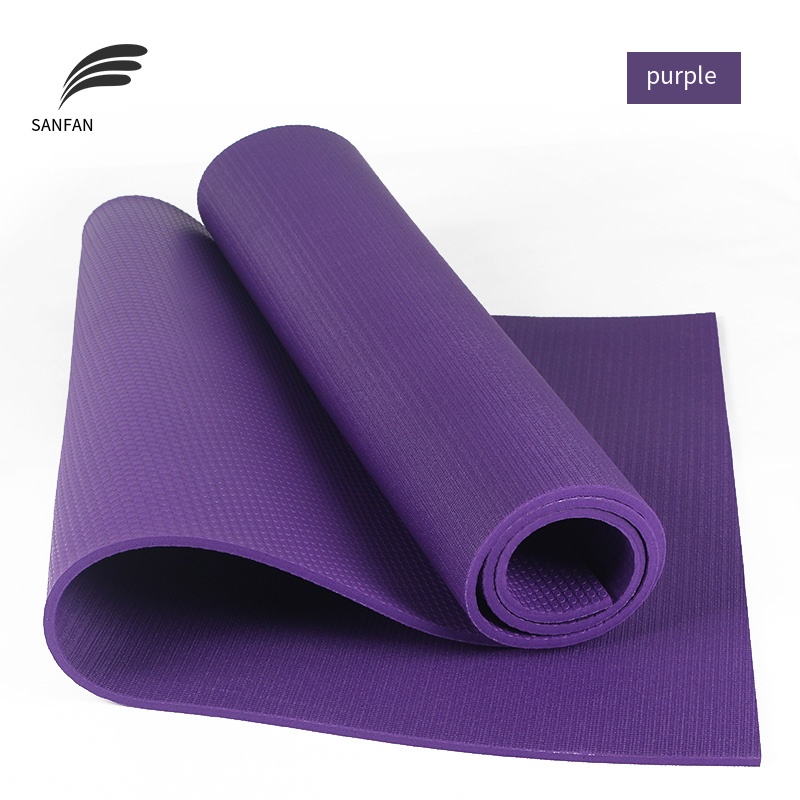
The lengths we actually make
The fastest way to answer the question for a real order is to read the size string in the product name. Our mats are named material first, then length, width and thickness in centimetres. A PVC 183*61*0.6cm mat is 183 cm long. A matte PU and natural rubber 185*68*0.45cm mat is 185 cm long. A TPE 185*80*0.6cm mat is also 185 cm long, on a much wider deck.
Notice what moves and what does not. Length barely changes across those three products. Width goes from 61 cm to 68 cm to 80 cm, and thickness and material change completely. That is the pattern across everyday mats in general: makers treat length as close to fixed and use width, thickness and surface to create different products. So when a buyer asks how long a mat is, the honest short answer is one of two numbers, and the more useful follow-up is which width goes with it.
| Product | Length | Width | Thickness | Material |
|---|---|---|---|---|
| PVC premium mat with alignment lines | 183 cm | 61 cm | 0.6 cm | PVC |
| Matte professional mat with alignment lines | 185 cm | 68 cm | 0.45 cm | Frosted PU + Rubber |
| Double color premium mat | 185 cm | 80 cm | 0.6 cm | TPE |
How to measure a mat's length properly
Length is the long edge of the deck, measured flat. It sounds obvious, but three small details cause most of the disagreements between a buyer and a factory during sampling.
- Measure it unrolled and rested. A mat that has just come out of a tight roll curls at both ends and reads short. Lay it flat and let it settle before you put a tape on it.
- Measure the deck, not the print. Printed designs and laser alignment lines sit inside the edge. The usable printed area is always a little shorter than the deck, so ask for the artwork template instead of assuming the full length is printable.
- Agree the unit. Our product names use centimetres. If your retail listing needs feet and inches, convert from the centimetre figure on the specification, and keep the centimetre figure as the one both sides sign off.
Soft materials also behave differently from rigid ones. Rubber, TPE and PVC are cut from sheet, and a cut edge on a flexible sheet is never as exact as a machined part. Ask your supplier what cutting tolerance applies to the product you are buying, and write that tolerance into the order details. We do not publish a single tolerance figure here because specs vary by product.
Is a standard length long enough for you?
A simple check works better than a height chart. Lie flat on your back on the floor and have someone mark where your head and heels land. If both marks fit inside the deck length with a little room to spare, a standard mat covers you for resting poses, which is where length matters most. In standing work, your feet and hands land well inside the deck, so length is rarely the limit there.
What people often experience as a mat being too short is actually a mat being too narrow or too slippery. Hands drifting off the side in a wide stance is a width problem. Feet sliding forward in a long hold is a grip problem. Check those two before you decide the answer is a longer deck.
Which length to choose
These verdicts use only the sizes listed above, so each one points at a product you can open and check.
- If you want the common size that fits ordinary mat bags, shelves and studio racks, choose a 183 cm deck such as the PVC 183*61*0.6cm mat. Accessories are designed around this footprint, which keeps your range simple.
- If you want a little more room without leaving standard territory, choose a 185 cm deck on a 68 cm width, such as the matte PU and rubber 185*68*0.45cm mat. The extra space is mostly sideways, which is where practitioners notice it.
- If your customers are broad-shouldered or simply like space, choose 185 cm on an 80 cm width, such as the TPE 185*80*0.6cm mat. Check that your carry strap or bag is made for the wider roll.
- If you need a deck clearly longer than 185 cm, do not pick any of the three products above. None of them will meet that brief. That is a custom-size enquiry, and the right first step is to send us the length you need so we can confirm whether the material you want can be cut to it.
What length changes for a brand order
For anyone sourcing products rather than buying one mat, length feeds into several other decisions, and it is worth settling early.
Artwork. Print designs are built to a template for a specific deck. A design made for 183 cm does not drop onto 185 cm without adjustment, and moving between widths changes the composition far more. Create the artwork after the size is fixed, not before.
Alignment lines. Two of the mats above carry laser printed alignment lines that guide hand and foot placement. Those lines are positioned relative to the deck, so they are part of the size decision. If you plan custom markings, ask for the line layout alongside the size.
Packaging and delivery. Length sets the height of the rolled mat only when it is rolled along its length, which is the normal way. Width then becomes the length of the roll, and that is the dimension that decides carton size and how many pieces fit in a shipment. A wider deck costs more carton capacity than a slightly longer one.
Quality checks. Put the agreed length, width and thickness on the purchase order and ask for them to be checked during inspection. A high-quality run is one where the measured figures meet the written standards, and that only works if the standards were written down. Our manufacturing and OEM/ODM services start from that specification sheet for exactly this reason.
Frequently asked questions
How big is a standard yoga mat?
About 183 cm by 61 cm, roughly 6 feet long and 2 feet wide. Longer and wider decks exist, but the exact size always depends on the product.
How long is a yoga mat in feet?
A standard mat is roughly 6 feet long. Our product names give the exact figure in centimetres, 183 cm or 185 cm for the mats listed in this guide, and that centimetre figure is the one to use on a specification.
Are all yoga mats the same length?
No, but everyday mats sit in a narrow band. In our range the two standard deck lengths are 183 cm and 185 cm. Width varies much more, from 61 cm up to 80 cm across the three mats compared here.
Does a thicker mat need to be longer?
No. Thickness and length are independent. The 0.6 cm PVC mat above is 183 cm long, and the 0.45 cm matte rubber mat is 185 cm long. Thickness changes cushioning and rolled diameter, not how much of you fits on the deck.
How do I know if I need a longer mat?
Lie flat on the floor, mark head and heels, and compare that span with the deck length in the product name. If you fit with a small margin, a standard length is enough. If you only run out of room sideways, look at a wider deck before a longer one.
Can Printing Yoga make a custom length?
Send us the length, width, thickness and material you want. Whether a given size can be made depends on the material and how it is cut, so we confirm it per enquiry and do not promise a figure in advance. We will tell you plainly if a size is outside what we can make.