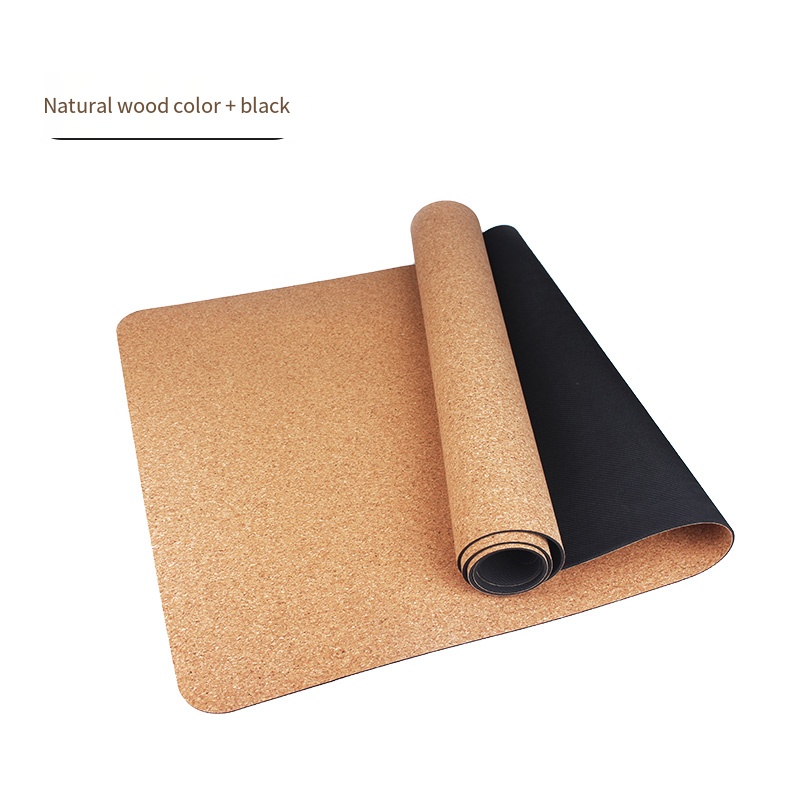
Cork yoga mats are generally non toxic: the cork face is pressed tree bark with no PVC and no plasticisers in it, and in our range it sits on a natural rubber or PU rubber base rather than a PVC body. What you still need to check is the rest of the mat, because a cork mat is a laminate of three things: the cork sheet, the base under it and the adhesive between them. Each one has its own safety story, and the honest answer to the question depends on all three.
What is actually in a cork yoga mat
Cork is the outer bark of the cork oak, granulated and pressed into a thin sheet. It contains no PVC, no phthalate plasticisers and no foam blowing agents, which is why it is the material most people reach for when they want a mat that does not smell of plastic. The bark is also naturally resistant to mould and bacteria, so the surface stays cleaner than a foam face between washes. On its own, cork is about as inert as a mat material gets.
A cork sheet alone is not a mat, though. It has very little cushion and it would crack if you rolled it, so it is bonded to a base that does the padding and holds the floor. In the two cork products Printing Yoga makes, that base is rubber: the full-length Cork + Rubber mat at 183*66*0.4cm uses a natural rubber body, and the ColorBlock Rubber/Cork panel at 97*57*0.45cm uses a PU rubber body. Neither build uses PVC anywhere in the stack. A cork mat from another factory may well sit on PVC or on a cheap foam, and in that case the cork face is doing the marketing while the base is doing the harm, so always read the base material in the product details and not just the word cork in the title.
The third ingredient is the adhesive that laminates cork to rubber. This is the part no product page talks about, and it is where a poorly made cork mat can let you down: a low-grade glue can keep off-gassing for weeks and can let the cork peel at the edges. A high-quality lamination is cured during manufacturing so that the mat arrives with little or no smell. If you want a non toxic mat rather than just a non toxic face, this is the line to ask about.
Cork mat ingredients, layer by layer
The table below splits the mat into its layers and says what each one means for safety. It applies to our two cork builds; use the same checklist on any cork mat you are considering.
| Layer | What it is in our cork mats | Safety point | What to ask a supplier |
|---|---|---|---|
| Face | Pressed natural cork sheet | No PVC, no plasticisers, naturally antimicrobial | Is the cork natural bark or a cork-look print? |
| Base | Natural rubber (183*66*0.4cm) or PU rubber (97*57*0.45cm) | PVC-free; natural rubber contains latex proteins | Which base material, and is any PVC used? |
| Adhesive | Lamination layer bonding cork to rubber | The usual source of new-mat smell if under-cured | How long is the smell at delivery, and can we see a test report for the batch? |
| Print and lines | Optional logo and alignment lines on the face | Printed on the surface, not mixed into the material | Which printing method, and does it change the feel of the cork? |
Two details in that table deserve a second look. First, natural rubber is not a synthetic plastic, but it does contain latex proteins, and people with a latex allergy react to it through skin contact; the PU rubber base on the ColorBlock panel is the one we would point those customers toward. Second, a cork-look print on top of a foam mat is not a cork mat at all, and it carries none of the properties above. How cork, rubber and PVC faces compare in use is a separate question, covered in our cork, rubber and PVC surface comparison; this page is only about what the materials are made of.
Is a cork yoga mat the right non toxic choice for you?
If your main concern is avoiding PVC and plastic smell, a cork mat on a rubber base is one of the cleanest builds you can buy. The face is bark and the base is rubber, and the only synthetic component in the stack is the lamination layer. Pick the 183*66*0.4cm Cork + Rubber mat for a full-length practice mat.
If you or your students have a latex allergy, do not choose the natural rubber base. Cork itself is latex-free, but a natural rubber body is not, and it is the body your skin touches at the edges and underside. The 97*57*0.45cm ColorBlock panel sits on PU rubber instead, and for a full-length latex-free mat a different base material is the right conversation to have with us before you order.
If you want a mat that stays hygienic between cleans, cork earns its place. The bark surface resists mould and bacteria on its own, it wipes down with water and mild soap, and it does not need the deep scrub that an open-cell foam face does. For a studio that cleans a class set every day, that is a real saving in time and in cleaning chemicals.
If you are comparing cork against a foam mat sold as eco friendly, read the base material of both before you decide. Many foam mats are non toxic in the sense of containing no PVC, and we go through that case in our guide to whether TPE is toxic; what cork adds is a natural face that does not glaze or shed with wear.
If you are a brand or studio buying in bulk, a cork mat is non toxic only if every batch is made to the same spec. Ask for the base material and the adhesive to be written into the order, request a sample from the production run rather than a showroom piece, and ask for the batch test report with the delivery. These are routine requests for a factory, and they are the only way to ensure the hundredth mat matches the first.

How we make our cork mats, and what we can put in writing
Both cork products in our range are factory-direct, so the material details come from the production line rather than from a trading company's listing. The cork face is natural bark sheet, the bases are natural rubber and PU rubber, and PVC is not used in either build. Logos and alignment lines are applied on the surface by printing, so they add nothing to the material stack, and both mats can be ordered from a single piece, which lets you test a sample at a low cost before committing to a class set or a branded run.
What we deliberately do not do on this page is quote certification numbers, emission figures or weights as if they were fixed. Those details vary by product, by batch and by the test standards your market asks for, and a figure copied from one batch to another is exactly the kind of claim that makes a non toxic label meaningless. If your market requires a specific standard, tell us at the quotation stage; our manufacturing services cover testing to the standards you name, and the report travels with the goods. The capacity to make a custom cork mat to the same high-quality spec as our stock product is the point of ordering from the factory, and if you want to create your own designs on a cork face, the printing options are described on the product pages above.
For the broader question of what eco actually means on a mat spec sheet, which overlaps with but is not the same as non toxic, our guide to environmentally friendly yoga mats sets out the terms we use and the ones we avoid.
Frequently asked questions
Do cork yoga mats contain PVC?
The cork face never does; it is pressed bark. The base is where PVC can appear on some mats. Both Printing Yoga cork mats use a rubber base, natural rubber on the 183*66*0.4cm mat and PU rubber on the 97*57*0.45cm panel, with no PVC in either. If a product page does not name the base material, ask before you buy.
Why does my new cork yoga mat smell?
The bark face itself has almost no odour. What you notice on a new mat comes from the rubber body or from the adhesive that laminates the face to it, and it is strongest when the glue has not been fully cured. A properly made mat arrives with a faint rubber note that fades after a few days of airing; a strong chemical odour that lasts weeks points to a low-grade adhesive.
Are cork yoga mats safe for people with a latex allergy?
The cork face is latex-free, but a natural rubber body is not, and it is exposed at the underside and edges. Someone with a latex allergy should choose a cork mat on PU rubber, such as our ColorBlock panel, or ask us about a different body material for a full-length mat.
Is cork antibacterial on its own?
Yes. Cork bark contains a natural wax that makes the surface resist mould and bacteria, which is why cork mats stay fresher than foam between cleans. It is not a substitute for cleaning, but it does mean a wipe with water and mild soap is usually enough, and you do not need harsh sprays on the surface.
Can a cork mat be printed and still be non toxic?
Yes. Logos and alignment lines on our cork mats are printed on the surface rather than mixed into the material, so they do not change what the mat is made of. The ink is the only thing being added, and it is the kind of detail you can ask us to confirm on the test report for your batch.
How do I check that a bulk order of cork mats is really non toxic?
Put the base material and the adhesive in the purchase order, take a sample from the production run and keep it, and ask for the batch test report to ship with the goods. A factory that makes the mats itself can meet those requests as a matter of course; a listing that cannot name its base material cannot.